BPC-157 + TB-500 Blend Dosage Calculator: Reconstitution & Concentration Math (2026)
BPC-157 + TB-500 Blend Dosage Calculator: Reconstitution & Concentration Math
The math researchers actually need when working with a BPC-157 + TB-500 blend: reconstitution ratios, mg/mL concentration, and per-component math for a multi-peptide vial. For laboratory research use only — not a personal dosing tool.
Table of contents
- Why “dosage calculator” searches lead here instead of a dosing chart
- Reconstitution math: going from mg to mg/mL
- The extra step for a 4-component blend
- Worked example
- Common concentration-math mistakes
- FAQ
Why “dosage calculator” searches lead here instead of a dosing chart
A lot of people searching for a “BPC-157 TB-500 dosage calculator” are actually looking for two different things: (1) a concentration calculator — how much peptide is in each mL after reconstitution — and (2) a personal dosing chart. This page only covers the first one. BPC-157 and TB-500 are not FDA-approved for any use, there is no standardized human dosing protocol for either, and we’re not going to publish one. What we can walk through is the concentration math every researcher needs regardless of what protocol they’re studying: how to go from a lyophilized vial to a known mg/mL solution.
Reconstitution math: going from mg to mg/mL
The core formula is simple:
Concentration (mg/mL) = Total peptide content (mg) ÷ Volume of bacteriostatic water added (mL)
Example: a single-peptide vial containing 5mg of lyophilized powder, reconstituted with 2mL of bacteriostatic water, yields a 2.5mg/mL solution. That’s straightforward for a single-peptide vial. It gets more involved for a blend.
The extra step for a 4-component blend
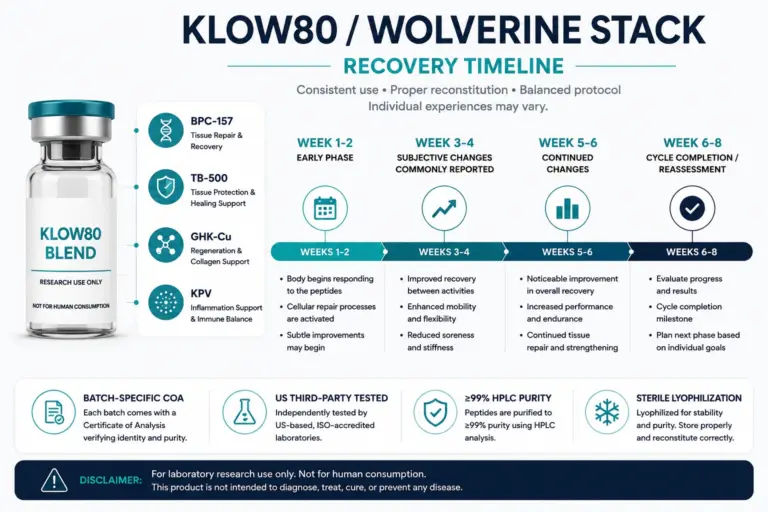
Klow80 Blend combines BPC-157, TB-500, GHK-Cu, and KPV in a single 80mg-total vial — not an even 20mg-per-component split. The blend’s exact composition ratio is stated on the Certificate of Analysis (CoA) that ships with every batch, and that ratio is what determines each component’s individual concentration after reconstitution, not an assumption. The general math is:
Per-component concentration (mg/mL) = (Total blend concentration × component’s % of blend, per CoA) ÷ 1
Researchers used to working with single-peptide vials sometimes skip this step and assume an even split across all four components. That’s the single most common calculation error we see referenced in community discussion — always pull the actual ratio from the batch-specific CoA rather than estimating.
Worked example
Say a 80mg Klow80 Blend vial is reconstituted with 4mL of bacteriostatic water:
- Total blend concentration = 80mg ÷ 4mL = 20mg/mL (all four components combined)
- If the CoA states the blend is (for example) 50% BPC-157, 30% TB-500, 15% GHK-Cu, 5% KPV by weight, the per-component concentrations in that same 4mL solution would be: BPC-157 ≈ 10mg/mL, TB-500 ≈ 6mg/mL, GHK-Cu ≈ 3mg/mL, KPV ≈ 1mg/mL.
These figures are illustrative of the math process only — not a representation of Klow80 Blend’s actual published ratio. Always use your batch’s real CoA numbers, not a generic split.
Common concentration-math mistakes
- Assuming an even split across blend components instead of checking the CoA.
- Mixing up total peptide weight with total solution volume — concentration is mg of peptide per mL of final solution, not per mL of water added before the powder dissolves.
- Not accounting for dead space in a syringe or vial, which can slightly skew real-world draw volume versus calculated volume.
- Reusing an old concentration figure after a new batch with a different CoA ratio.
Storage and handling reminder
Concentration math only matters if the reconstituted solution is stored correctly. See our full dosage & reconstitution guide for storage conditions, or the dedicated storage & handling FAQ. If you’re wondering why the blend pairs BPC-157 with TB-500 in the first place, our breakdown of how the two peptides differ mechanistically covers that.
Where to source a blend with a stated CoA ratio
Klow80 Blend ships with a Certificate of Analysis for every batch, stating the exact composition ratio referenced above — not a generic assumption. HPLC-verified to ≥99% purity, available through our verified store partner, Peptryn.
FAQ
Is there an official BPC-157 + TB-500 dosage calculator?
No. Neither peptide is FDA-approved, and there’s no standardized dosing protocol published by a regulatory body. What exists is reconstitution/concentration math (covered above), which is a measurement calculation, not a dosing recommendation.
How do I know the exact ratio in a Klow80 Blend vial?
Check the Certificate of Analysis (CoA) that ships with your specific batch. It states the actual composition ratio rather than assuming an even split across the four components.
Does the calculation change between batches?
The concentration formula (total mg ÷ mL of water) stays the same, but the per-component split can vary slightly batch to batch, which is why the CoA — not a fixed generic number — is the source of truth.
What’s the difference between this and a dosing chart?
A concentration calculator tells you how much peptide is in a given volume of solution. A dosing chart would tell you how much to administer — which requires a standardized protocol that doesn’t exist for these compounds. This page only covers the former.
Related guides
- BPC-157 + TB-500 + GHK-Cu + KPV Blend Dosage Guide
- BPC-157 + TB-500 Recovery Timeline: What the Community Reports
- Where to Buy Klow80 Blend: Buyer’s Guide
- Klow80 Blend Storage, Handling & FAQ
- BPC-157 vs. TB-500: How the Two Peptides Differ
Research-Use Disclaimer: This content covers concentration/reconstitution math for laboratory research use only. It is not a dosing recommendation and not intended for human or animal administration. BPC-157, TB-500, GHK-Cu, and KPV are not FDA-approved for any use.