Wolverine Stack (BPC-157 + TB-500): Recovery Timeline & What the Community Reports
Table of Contents
- Why It’s Called the “Wolverine Stack”
- What’s Actually in the Stack
- Week-by-Week: What the Community Reports
- What GHK-Cu and KPV Add in Klow80
- Real Recovery Reports From the Community
- The Other Side: A Real Adverse-Effects Report
- FAQ
- The Honest Take
- Research-Use Disclaimer
Why It’s Called the “Wolverine Stack”
“Wolverine Stack” is the nickname the research and biohacking community gave to the combination of BPC-157 and TB-500 — a nod to the Marvel character’s fictional rapid-healing ability. It shows up constantly across Reddit communities like r/Peptides, r/bpc_157, and r/Biohacking, in posts discussing joint, tendon, and soft-tissue recovery research. Klow80 Blend is essentially an expanded version of that same combination, adding GHK-Cu and KPV into a single vial rather than requiring four separate compounds.
What’s Actually in the Stack
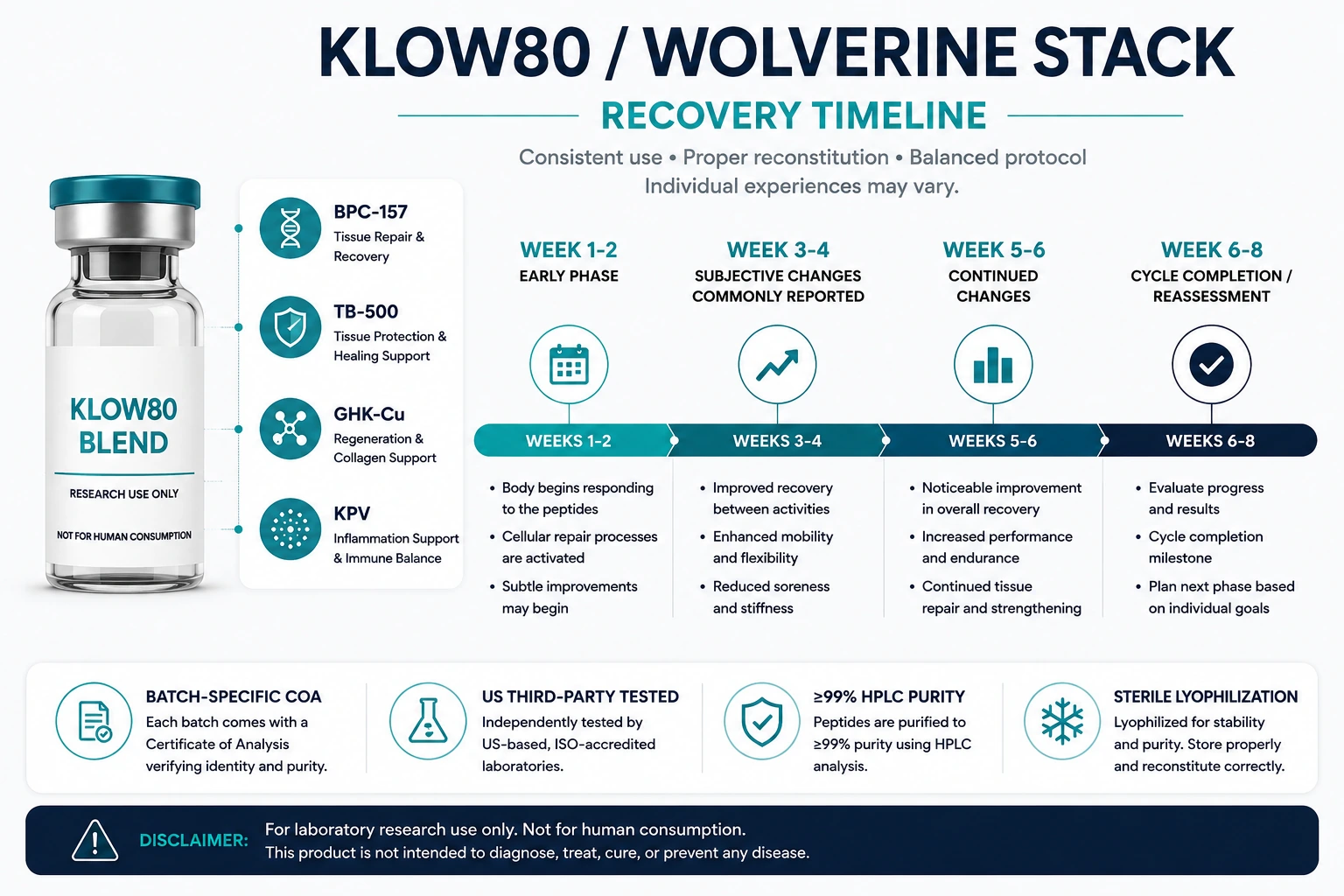
- BPC-157 — a synthetic peptide derived from a protective protein found in gastric juice, most discussed in research contexts related to soft-tissue and gut-lining recovery.
- TB-500 — a synthetic fragment related to thymosin beta-4, discussed in research contexts related to cell migration and tissue repair signaling.
- GHK-Cu — a copper-binding peptide studied for skin, collagen, and wound-healing research applications. See our full GHK-Cu research overview.
- KPV — a tripeptide fragment of alpha-MSH studied in anti-inflammatory research contexts. See our full KPV research overview.
For dosing specifics across all four components, see our Klow80 Blend dosage guide.
Week-by-Week: What the Community Reports
This is a compiled pattern drawn from multiple community-reported research logs and discussion threads — not a clinical study, and individual reports vary widely. Treat it as a rough shape of what gets discussed, not a guarantee:
- Week 1–2: Reports in this window are the most mixed — some describe early subjective changes, many describe no noticeable difference yet and caution others against expecting early results. This is also the window where injection-site reactions, if any, tend to be reported.
- Week 3–4: The most common point where community members report starting to notice subjective changes in the area of research focus (commonly joint or tendon-related discussion threads). This lines up with typical soft-tissue research timelines discussed in the community, though it’s frequently emphasized that individual variation is large.
- Week 5–6: Reports in this window more often describe continued or compounding subjective changes rather than new onset. Some threads discuss extending a research cycle into this range specifically because earlier weeks showed partial but incomplete change.
- Week 6–8+: Threads discussing full research cycles (commonly 6–8 weeks total) most often appear in this window, along with post-cycle discussion of whether to continue, pause, or reassess.
A recurring, important caveat across nearly every thread that includes a timeline: recovery-oriented research self-reports are inherently subjective, unblinded, and confounded by everything else going on in a person’s life at the same time (training load, sleep, other supplementation). The community itself flags this regularly — it isn’t something we’re adding as an outside disclaimer.
What GHK-Cu and KPV Add in Klow80
The base Wolverine Stack (BPC-157 + TB-500) is the combination with the most community discussion history. GHK-Cu and KPV are less frequently discussed in the same threads, but come up specifically in two contexts: GHK-Cu in skin/collagen-focused research discussion, and KPV in gut and inflammation-focused research discussion. Klow80 combines all four into one blended vial specifically for researchers who want to study the combination without managing four separate reconstitution schedules.
Real Recovery Reports From the Community
Reddit (opened and read in full): Multiple first-person recovery-timeline posts across r/bpc_157 and r/Biohacking describe multi-week research logs tracking subjective changes across the Week 1–8 range described above. One thread in r/Peptidesource included a direct, organic mention of “KLOW80” by name from a real user discussing the blended-vial approach specifically — independent confirmation that the product name has organic recognition in the community, not just from vendor marketing.
The Other Side: A Real Adverse-Effects Report
In the interest of giving a balanced picture rather than only positive reports, community discussion also includes negative and adverse-effect accounts — injection-site irritation, no perceived change despite a full cycle, and in some threads, concern about unregulated sourcing quality being the actual variable rather than the compounds themselves. We’re not going to cite unverified medical claims here, but it’s worth being direct: not every community report is positive, and source quality (a real, batch-specific COA) is repeatedly the variable that separates good and bad experiences in these threads.
FAQ
How long does a typical BPC-157 + TB-500 research cycle run in community discussion? Most-discussed cycle lengths fall in the 4–8 week range, with 6–8 weeks being the most commonly referenced full cycle in recovery-focused threads.
Is Klow80 the same as the “Wolverine Stack”? It’s an expanded version — the base Wolverine Stack refers specifically to BPC-157 + TB-500, while Klow80 blends those two with GHK-Cu and KPV in a single vial.
Do results show up quickly? Community reports most commonly describe noticing subjective changes starting around week 3–4, not immediately, and caution against expecting early results.
The Honest Take
The “Wolverine Stack” nickname is fun, but it’s worth taking seriously that everything in this article is self-reported, unblinded community discussion — not clinical evidence. What’s consistent across the threads we reviewed is the general shape of the timeline (slow start, changes reported mid-cycle, plateau or continuation decision by week 6–8) and the recurring emphasis on source quality as the biggest variable in reported outcomes. For full storage and FAQ details, see our Klow80 storage & FAQ guide.
See current Klow80 Blend options.
Research-Use Disclaimer
Klow80 Blend and its individual components (BPC-157, TB-500, GHK-Cu, KPV) are sold and discussed here strictly for laboratory research and educational purposes. None of these compounds are approved for human consumption, and nothing in this article constitutes medical advice. The timeline and reports described reflect unverified, self-reported community discussion, not clinical data. Consult a licensed physician before making any decisions related to your health.