KPV Peptide: Benefits, Dosage & What Research Shows
KPV Peptide: Benefits, Dosage & What Research Shows
KPV has become one of the most-searched research peptides on its own. Here’s what it actually is, what the inflammatory-response literature covers, and how it fits into a four-peptide blend. For research use only.
What is KPV?
KPV is a tripeptide (lysine-proline-valine) representing the C-terminal fragment of alpha-melanocyte-stimulating hormone (α-MSH). Despite being a very short sequence, KPV retains anti-inflammatory activity attributed to the parent α-MSH molecule in published research, without triggering the pigmentation effects associated with full-length α-MSH analogs like Melanotan II.
What the research covers
Published research on KPV has concentrated on inflammatory-response pathways — particularly gut and dermal inflammation models. Its small size and stability have made it a frequent subject in studies exploring localized anti-inflammatory mechanisms, and its lack of pigmentation activity is a recurring point of distinction researchers cite versus other melanocortin-pathway peptides. As with every peptide referenced on this site, this reflects published in vitro and animal research — not evidence of safety or efficacy in humans, and not a claim that KPV treats any condition.
How KPV dosing is referenced in the literature
KPV is not FDA-approved and has no official human dosing schedule. Research and community-reported protocols generally reference low-microgram-range concentrations, reflecting the compound’s high potency at small doses relative to larger peptides. Reported amounts vary by source and research context and should not be treated as instructions.
Reconstitution and storage
Like the other components in Klow80 Blend, KPV should be stored lyophilized at −20°C, reconstituted with bacteriostatic water added slowly and swirled (not shaken) to preserve the peptide structure, then kept at 2–8°C and used within 28 days once in solution.
KPV as part of a four-peptide blend
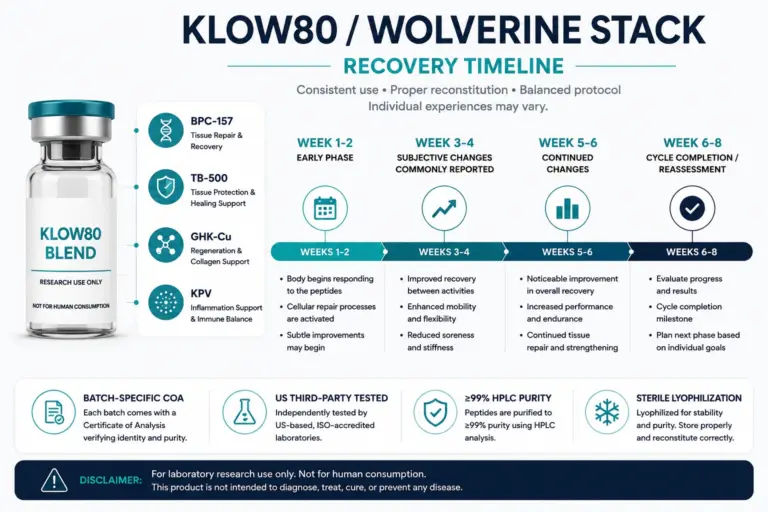
Klow80 Blend combines KPV with BPC-157, TB-500, and GHK-Cu at 80mg total peptide content per vial, independently HPLC-verified to ≥99% purity with a Certificate of Analysis per batch. Researchers evaluating KPV alongside tissue-repair-focused peptides in a single verified source use this blend rather than sourcing KPV in isolation.